The adult Western that changed radio drama, starring William Conrad as Marshal Matt Dillon of Dodge City.
How It Got Made
Gunsmoke didn't happen overnight. Producer-director Norman Macdonnell and writer John Meston spent roughly two years — starting in mid-1950 — developing the idea of an adult Western for radio before CBS gave them a green light. That development time mattered, because what they were trying to do had never been done. Radio Westerns up to that point were children's fare: The Lone Ranger, The Cisco Kid, Red Ryder. Clean heroes, tidy morals, nothing that would unsettle a nine-year-old. Macdonnell and Meston wanted something different — a Western that treated violence honestly, left things unresolved, and put a flawed human being at the center instead of a square-jawed symbol.
Macdonnell had been working as assistant director to William N. Robson on the drama anthology Escape when he started thinking seriously about the Western format. Meston, meanwhile, had become story editor at CBS. Both men understood how radio storytelling worked at a craft level, and both were dissatisfied with what the Western genre had been allowed to become. William N. Robson himself had produced a Western called Hawk Larabee in 1946–48 and later described it honestly as "a pictureless B-grade western — the same kind of plot and character development that you'd find in a Roy Rogers movie." That description captures exactly what Macdonnell and Meston were trying to escape.
They didn't pitch a concept in a vacuum. They tested their ideas inside existing programs first. On December 22, 1950, Macdonnell aired a Meston western story on Escape titled Wild Jack Rhett. Meston then wrote Pagosa, which Macdonnell produced on the CBS program Romance on August 6, 1951. These weren't just auditions for a future show — they were genuine experiments in a sound style: "exaggerated sound patterns," little or no narration, action carried mostly in dialogue, and what Macdonnell described to documentary filmmaker John Hickman as lots of dead air and audible sound effects. The idea was to strip away the busy clutter of conventional radio drama and let the listener's imagination do more of the work.
The opening finally came when CBS was canceling Robson's spy series Operation Underground. Macdonnell approached the network again about his Western, and this time CBS said yes — giving him one week to put the show together. Writer Walter Brown Newman was brought in to write the first script, with Macdonnell handing him acetate recordings of Pagosa and Wild Jack Rhett as style references. Gunsmoke premiered on CBS on April 26, 1952. It would run until June 18, 1961.
The Cast That Defined It
The anchor of everything was William Conrad as Matt Dillon, U.S. Marshal of Dodge City, Kansas — and CBS almost didn't cast him. The network objected because Conrad had built his film career playing heavies: he'd appeared in Body and Soul, Sorry, Wrong Number, and The Killers. CBS auditioned many actors before, according to Conrad himself speaking to John Hickman, calling him as a last resort. He read about two lines and was offered the job the next day.
What Conrad brought to the role wasn't a conventional hero's voice. He brought weight. The key scene in Newman's first script was a two-minute standoff between Dillon and a lynch mob, and Conrad delivered it with an intensity that Macdonnell later compared to Conrad's performance in the Escape episode Poison. Macdonnell said of opening night that "nobody was sure whether we had a hit or a miss," and in those early episodes, Conrad didn't play Dillon with much warmth. The warmth came gradually, as all four main characters developed into something more complex than their introductions suggested.
Parley Baer played Chester Wesley Proudfoot — Dillon's deputy — from the first episode to the last. Chester's full name came not from any writer's room decision but from Baer himself ad-libbing the line "Well, as sure as my name is Chester Wesley Proudfoot..." on air. Chester's first name, for that matter, came from Conrad, who suggested it. Newman's original script had listed the character only as "townsman." Baer pushed back against a critic who called Chester a "dimwitted town loafer," preferring the description "dependable nonthinker" — a meaningful distinction. As Baer explained to Hickman, Dillon trusted Chester as much as he dared trust anyone, but wasn't always certain Chester would function reliably under pressure. That tension is what made Chester interesting rather than merely comic.
Howard McNear played Dr. Charles Adams throughout the entire run. In the opening episode, Doc was written as almost vulturous — so delighted by the carnage from Dillon's guns that Dillon threatened to knock him down. The name was Conrad's suggestion, inspired by cartoonist Charles Addams, whose vampire-themed panels were popular at the time. McNear became, by all accounts, the emotional center of the cast. Parley Baer wept when speaking about him during Hickman's 1967 documentary, calling him "the dearest man." Conrad called McNear "the life of our cast." McNear suffered a stroke in 1963 that left the left side of his body nearly paralyzed; at Andy Griffith's personal request he returned to The Andy Griffith Show despite his disability, appearing in scenes carefully staged to hide his condition. He died of pneumonia at San Fernando Valley Veterans Hospital on January 3, 1969, at the age of 63. Baer — whose tears in Hickman's documentary had come two years earlier — delivered the eulogy at his funeral at the Los Angeles National Cemetery.
Georgia Ellis joined as the fourth regular within weeks of the premiere, playing Kitty Russell, the saloon girl at the Long Branch. Ellis had appeared in the opening episode in a different role — the widow of the murdered man — before stepping into the part that would define the series. Ellis described Kitty as "a generous, loving human being." In a 1953 Time interview, Macdonnell stated plainly that Kitty was a prostitute, though the show never said so explicitly. Ellis captured the relationship between Kitty and Dillon in a single line: "There was no forgiveness to be given, because I don't think Kitty was available to anybody but Matt."
The Way It Sounded
Macdonnell and Meston had specific ideas about sound before they ever put a script on paper, and those ideas shaped everything Gunsmoke became. No narration. Dialogue doing the work of exposition. And a level of sonic detail that had no precedent in radio Westerns — the squeak of Matt's pants against saddle leather, the individual keys dropping on a key ring, the dull clink of spurs, the creak of nails in boardwalk planks, background conversation in the saloon, a dog barking in the distance. Sound effects were handled by Tom Hanley, Ray Kemper, and Bill James, and the accumulated effect was a texture so specific that listeners weren't just hearing a Western — they were standing on Front Street in Dodge.
The music worked the same way. Rex Koury had never written for a Western before Gunsmoke. Macdonnell told him he wanted "a big, wide-open sound to it, something that suggested the wide-open spaces." Koury wrote the interior music first, then worked backward to develop the theme that would tie it together. As it happened, Koury overslept on the morning of the first broadcast and only remembered he hadn't written the theme while he was shaving. He sat down and composed it in ten minutes. That theme became one of the best-known pieces of music in radio history.
The opening signature of the show set the tone precisely: "Around Dodge City, and into territory on west, there's just one way to handle the killers and the spoilers: that's with a U.S. Marshal, and the smell of gunsmoke!" Then came Dillon's first-person introduction — describing himself as the first man killers look for and the last man they want to meet. It was economical, direct, and a little ominous. No guitar-strumming. No "Hi-yo Silver." Just the wind and the threat of violence.
The show drew critical comparisons to Jack Webb's Dragnet for its realism, though the two shows sounded nothing alike. The shared quality was commitment — an insistence on getting the texture of a world right rather than approximating it. Announcers Roy Rowan and George Walsh carried the commercial segments. During the Chesterfield sponsorship period from July 1954 through part of 1957, George Fenneman served as announcer. Post Toasties had sponsored the show before that, from October to December 1953, and from 1957 onward multiple sponsors shared the load.
What Meston Wrote
John Meston's writing is the reason Gunsmoke held together across nearly a decade. In the show's second year, Meston left his position as CBS story editor to write for Gunsmoke exclusively, and for roughly three years after that he was virtually the only author the show had — turning out about forty scripts a year.
Meston described his process in 1955 as starting with a story type (Indian story, Army story, Civil War background), then reaching into two sources: people he knew growing up in Colorado, and his reading about the West of the 1870s. Dodge City in the show was what writer Lucius Beebe had called "a suburb of hell" — a cow town and frontier outpost in the 1870s where violence wasn't a dramatic exception but a routine condition. The show didn't flinch from this. The violence in Gunsmoke regularly exceeded what radio horror shows attempted: mutilated bodies, men killed with axes or knives, families burned out, entire communities broken. Macdonnell described Dillon as "a lonely, sad, tragic man" who often lost — arriving too late to prevent a lynching, losing a patient after an amputation, watching a young woman slide into prostitution with nothing he could do to stop it.
Meston had put his intentions on record in a letter to the New York Tribune: he rejoiced in the freedom to destroy "the western guitar-thumping singing hero," writing "I spit in his milk." He described Dillon as "almost as scarred as the homicidal psychopaths who drifted into Dodge," adding: "Life and his enemies have left him looking a little beat-up. There'd have to be something wrong with him or he wouldn't have hired on as a United States marshal in the heyday of Dodge City, Kansas." That's not a hero's biography. It's a character study of a man who chose a life that cost him something, every week, without accumulating any visible reward.
Macdonnell described Meston's style as "understated and simple." Conrad added texture to that description, calling the writing "seasoned and highlighted by red streaks of magnificent violence" but ultimately filled with "a final total compassion with whatever the problem was." Both descriptions are accurate and they don't contradict each other — the understatement was the container; the compassion was what the violence finally pointed toward.
Other writers contributed over the run — Herb Purdum, Les Crutchfield, Antony Ellis, Kathleen Hite, John Dunkel, and Marian Clark among them — but Meston's voice set the standard everything else was measured against. He wrote 183 of the radio episodes and another 196 for the television series — 379 in all across both versions, an output that for sheer industrial productivity has few peers in American dramatic writing. The formal recognition was thinner than the output deserved: Meston received exactly one Emmy nomination in his entire career, for the 1958 Gunsmoke teleplay "Born to Hang," in the half-hour category. He died on March 24, 1979, of a cerebral hemorrhage in Tarzana, California, at the age of 64. He was working on a screenplay for John Frankenheimer at the time.
Recording Sessions and the People Behind Them
The recording sessions for Gunsmoke became known among the cast and crew as "dirty Saturdays," a name that captures their atmosphere accurately. Conrad, Baer, McNear, and Ellis were joined each week by a rotating company of character actors that included, at various points, Vic Perrin, John Dehner, Harry Bartell, Lawrence Dobkin, Sam Edwards, Virginia Gregg, Jeanette Nolan, John McIntire, and many others drawn from Hollywood's Radio Row. Perrin said that doing Gunsmoke was more fun than attending the Academy Awards.
Conrad himself had arrived at the role with a fuller history than the casting agents probably knew. He had served as a fighter pilot in World War II, commissioned at Luke Field, Arizona in 1943, and left the Army Air Forces as a captain and a producer-director of the Armed Forces Radio Service. After the radio era ended he spent fifteen years under contract to Warner Brothers as a producer-director, helming pictures including Two on a Guillotine, Brainstorm, and My Blood Runs Cold (all released in 1965). His voice kept finding new homes on television — narrating Rocky and Bullwinkle, Dudley Do-Right of the Mounties, The Fugitive, and Hoppity Hooper across the 1960s — before he returned to leading-man work as the title character of Cannon. He was posthumously elected to the National Radio Hall of Fame in 1997 and also honored by the Broadcasting and Cable Hall of Fame.
The sessions generated a body of outtake material that survived on tape alongside the broadcast episodes. In one, Conrad struggles repeatedly to say the words "sod hut" while the cast laughs around him. In a late-1955 rehearsal of the episode New Hotel — which aired in its polished form on February 19, 1956 — Rex Koury's musicians broke into "I Don't Want to Set the World on Fire" during a fire scene and brought the session down in laughter. During that same rehearsal, a digestive indiscretion at the microphone prompted the line "That goddamn shrimp curry does it every time," reducing Conrad to helpless laughter. These moments don't undercut the serious work the show was doing — they're the evidence of what made it possible to do that work week after week for nine years.
The Television Question
As early as 1953 there was talk of adapting Gunsmoke for television. Macdonnell told the press that "our show is perfect for radio" and that a Gunsmoke confined by a picture couldn't be as authentic. Behind the scenes he was intrigued by the possibility. The problem was William Conrad. Conrad had gained significant weight, and his appearance was very different from what listeners had built up in their imaginations over two years of radio. CBS gave the radio cast only a token audition — prompted, reportedly, by a persistent newspaper columnist — before taking the television version away from Macdonnell and casting a new ensemble.
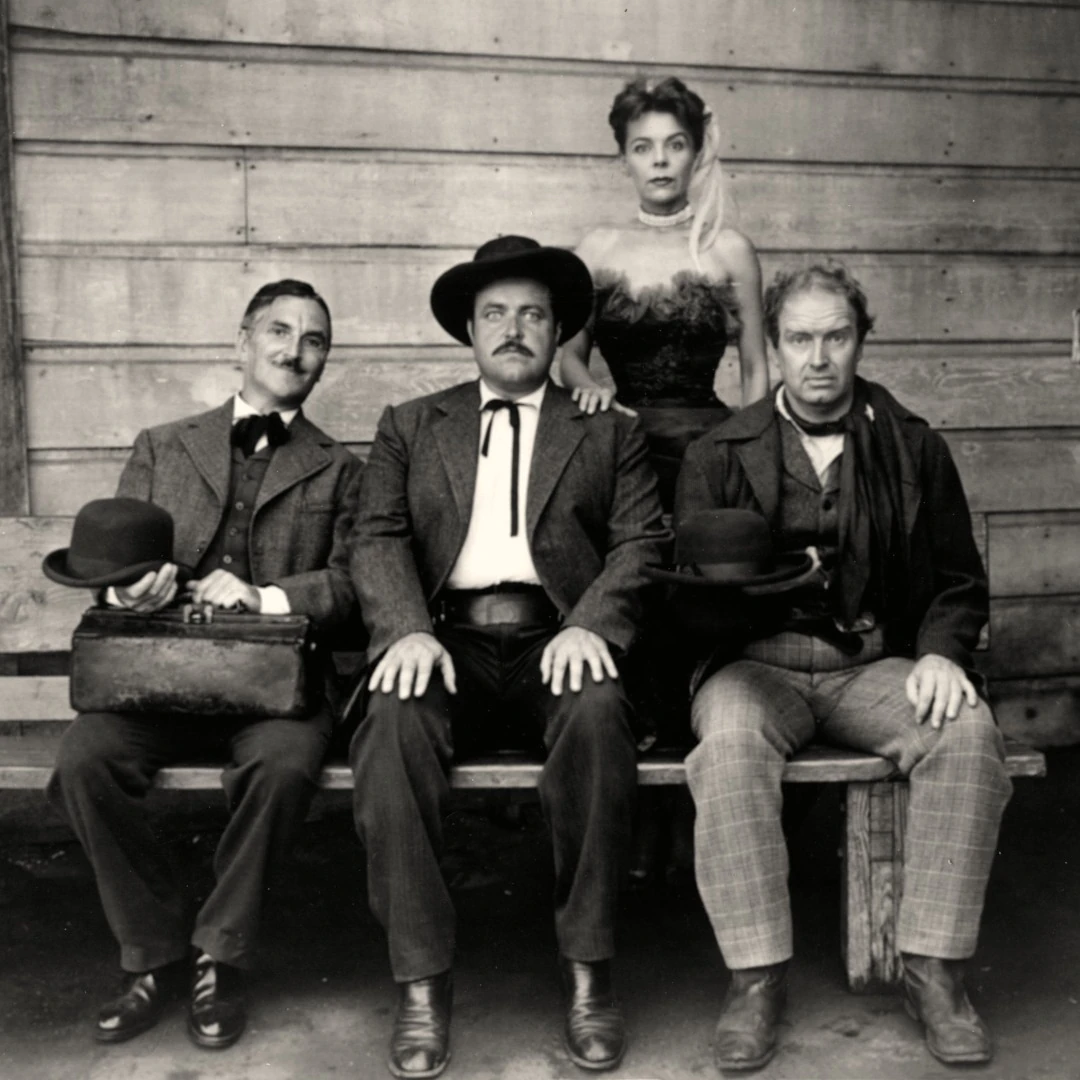
The arrangement that resulted was a compromise that satisfied no one entirely: Charles Marquis Warren would direct the television show, Macdonnell would be allowed to produce, and Meston would continue as writer. James Arness played Dillon. Amanda Blake played Kitty. Milburn Stone played Doc Adams. Dennis Weaver played Chester — with a wooden leg added and a heavier drawl, and the surname changed from Proudfoot to Goode. Weaver eventually came to hate the role, which Parley Baer found quietly remarkable. In a 1984 interview, asked about Weaver finding the role confining, Baer responded: "That is interesting, as if such a thought had never occurred to him."
Macdonnell's exile from the television show was temporary. Warren handled the first season; Macdonnell took over as TV producer in the show's second season in 1956 and guided it through four straight seasons, from 1957 through 1961, as the number-one-rated program on network television. He left the TV Gunsmoke after the 1964–65 season, then moved to NBC as executive producer of The Virginian, a post he held until 1971. He also produced The Road West in 1966–67 and the Universal feature The Ballad of Josie in 1967. He died of kidney failure in Burbank on November 28, 1979 — less than three weeks after his sixty-third birthday, and exactly eight months after Meston.
Conrad found the loss of the original television role bitter and became difficult to reach for anyone wanting to talk about his radio career. A generation of viewers grew up knowing only the TV Gunsmoke and not the original with Conrad's voice at the center of it. Radio fans of the time considered the television show a sham and its players impostors. The continued quality of Meston's scripts kept it from actually being one.
What Survives and What It Adds Up To
Virtually every episode from the first four years of the radio show survives. The dress rehearsal recordings that were preserved add something beyond the finished episodes — they document the working process and the human texture of the ensemble in a way that finished broadcasts don't. SuzAnne and Gabor Barabas published Gunsmoke: A Complete History through McFarland in 1990, an 836-page volume covering both the radio and television versions, with cast reminiscences, photographs, and show-by-show descriptions including titles, dates, story synopses, and players for every episode. John Hickman's 1967 five-hour radio documentary drew on interviews with Macdonnell, Conrad, Baer, Ellis, and others while memories were still fresh and the principals were still willing to talk.
The series also had a second life on the other side of the world. An Australian production of Gunsmoke, entirely separate from the U.S. version, began in 1955, was transcribed under the Artransa label, and aired Mondays at 7:00 PM on the Macquarie network. The total length of its run isn't known, but its existence is part of what makes recent rediscoveries possible: the episode "Homely Girl," written by Kathleen Hite and lost for decades, turned up in Australia in 2014 as an AFRTS recording. In 2019, the Library of Congress selected the December 27, 1952 episode "The Cabin" — in which Dillon, near death in a blizzard, seeks shelter in a cabin where two psychotic outlaws are holding a young woman hostage — for preservation in the National Recording Registry, describing the radio Gunsmoke as "probably the last new radio drama to make an impact" and noting that it "dealt with domestic violence and discrimination" alongside the expected stagecoach robbers and cattle rustlers.
The television series outlived the radio one by nearly fifteen years, and even it came close to ending earlier than it did. CBS planned to cancel the show in 1967 after its twelfth season. William S. Paley and his wife were avid fans and intervened personally; Gunsmoke was given a new Monday-at-eight timeslot, climbed back into the Nielsen top ten, and ran until 1975. The cancellation that had to happen somewhere fell instead on Gilligan's Island. When the television series finally ended, Los Angeles Times columnist Cecil Smith offered the valediction: "Gunsmoke was the dramatization of the American epic legend of the west. Our own Iliad and Odyssey, created from standard elements of the dime novel and the pulp Western as romanticized by Buntline, Harte, and Twain. It was ever the stuff of legend."
What those documents and that long afterlife together preserve is a record of radio craft operating near its ceiling. The show's signal achievement was demonstrating that a genre radio had treated as a children's delivery vehicle could carry genuine moral weight — violence with consequences, characters with histories, situations that didn't resolve neatly. Dillon lost regularly. Chester was unreliable at the worst moments. Doc had started out taking dark satisfaction in the body count. Kitty's presence meant something everyone understood and nobody said aloud. That combination of honesty and restraint, delivered through a sound design that put the listener in Dodge City rather than merely describing it, is what made nine years of Saturday and Sunday evening radio sustain an audience that was paying attention.